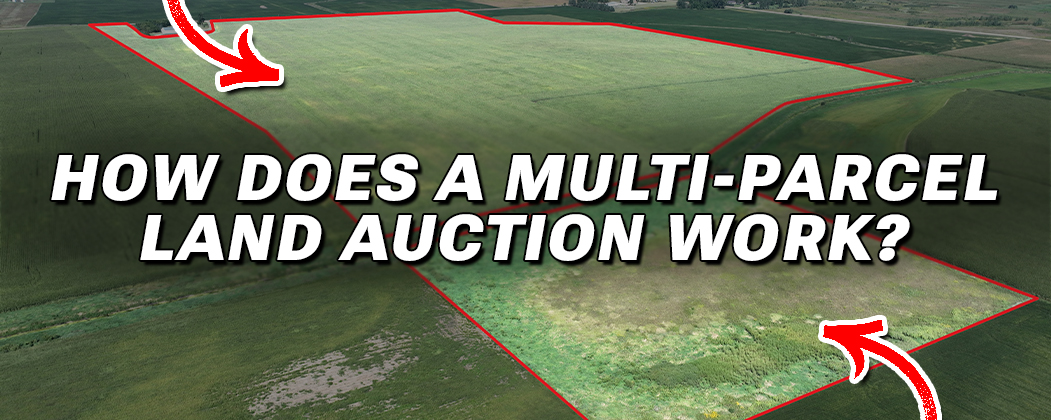
A multi-parcel land auction gives buyers more than one way to purchase a property. Instead of selling a whole farm or ranch as a single package, the land is divided into tracts, so buyers can bid on the piece or pieces that fit their plans.
That flexibility tends to bring a wide range of buyers to the table. A neighbor may be interested in the field that borders his ground. A young family may have their eye on the building site. An investor may want the best tillable acres, and another buyer may hope to take the whole property. The auction format determines how all of those interests come together.
You’ll hear a few terms used for this kind of sale, including “multi-parcel,” “Buyer’s Choice,” “tract bidding,” and “linked tracts.” Each one describes a slightly different way of bidding. Knowing which one applies to your sale makes the whole process easier to follow.
Why should I read the auction terms before bidding on land?
The terms explain exactly how a particular sale will work, and each land auction has its own. They cover:
-
whether bidding is per acre or as a lump sum
-
whether tracts sell individually or in combinations
-
whether the seller confirms the high bid
-
whether a buyer’s fee applies
-
how much the down payment is
-
when closing takes place
To give you an idea, a typical set of Steffes land auction terms covers points like these:
-
Anything announced or published on auction day takes precedence over earlier advertising.
-
The sale isn’t contingent on financing, an appraisal, or other buyer contingencies.
-
In many of our online land auctions, a 10% down payment is due the day bidding closes, and contracts are signed electronically.
Every sale is a little different, so the terms for the property you’re interested in are always the best guide.
It also helps to spend some time with the property information before auction day. Most land auctions include materials like these:
-
tract maps and survey information
-
legal descriptions
-
leases and possession dates
-
access and easements
-
soil data
If you have questions about any of it, your Steffes representative is happy to walk through it with you. It’s also a good idea to loop in your lender, attorney, and tax advisor early. Because land auctions typically don’t include buyer contingencies, having those conversations ahead of time lets you bid with confidence on auction day.
What is a multi-parcel land auction?
A multi-parcel auction is a sale where more than one tract is offered. How those tracts sell can vary from one auction to the next.
Some auctions offer each tract one at a time. Others let buyers bid on individual tracts as well as approved combinations of tracts. When combinations are allowed, the bidding determines whether the land sells in pieces, in groups, or as one larger package.
It’s worth knowing that the term is used a little differently across the industry. Some auction companies use “multi-parcel” to mean one specific process, where a price is set on each tract before bidding opens on combinations. Others use it more broadly for any sale with more than one tract. If you’re ever unsure how a sale is set up, the terms and your representative can clear it up quickly.
Dividing land into tracts often brings more buyers into the sale. Someone who isn’t looking for an entire property still has a reason to participate. A buyer interested in several neighboring tracts may also be able to bring them together, when the terms allow.
How does Buyer’s Choice work in a land auction?
In a Buyer’s Choice auction, bidders compete for the right to choose a tract rather than bidding on a specific one. It’s sometimes called bidder’s choice or high bidder’s choice, and it’s most often used when the tracts are similar to each other.
Here’s how it generally works:
-
Bidding opens with all eligible tracts available.
-
The high bidder earns the right to choose a tract, or more than one if the rules allow.
-
The selected tracts are set aside.
-
Bidding begins again on the remaining tracts, and the next high bidder chooses.
-
The rounds continue until every tract has sold.
Here’s a simple example. Four 80-acre tracts are offered by the acre, and the first round ends at $9,500 an acre. The winning bidder chooses Tract 2, for a price of $9,500 × 80 acres, or $760,000, before any buyer’s fee. Bidding then opens again on Tracts 1, 3, and 4.
In many Buyer’s Choice sales, a high bidder who wants more than one tract can take several at their winning per-acre price. The terms will explain whether that option is available and how the price applies.
The appeal of this format is that you get to choose the land that suits you best. Keep in mind that the order of selection can matter. If one tract has better access, a building site, or stronger soils, it may draw extra interest, and an early pick may take a stronger bid.
How does tract-by-tract bidding work?
With tract-by-tract bidding, each parcel is sold individually, so you always know exactly which tract you’re bidding on. In a live sale, bidding usually wraps up on one tract before moving to the next.
This format works especially well when the tracts are quite different. One might be mostly tillable, another might include a home and outbuildings, and a third might be pasture, timber, or recreational ground. Selling them separately lets each buyer focus on the land that interests them most.
It helps to understand how the final price is calculated. When a tract sells by the acre, the total is the per-acre bid multiplied by the acres stated in the terms. Depending on the sale, those may be deeded, assessor’s, or surveyed acres. If a new survey differs from the announced acres, the final contract price may be adjusted at closing.
If the sale includes a buyer’s fee, it’s added to the high bid. For example, an 80-acre tract that sells for $10,000 an acre has a bid price of $800,000. With a 5% buyer’s fee, the total contract price would be $840,000. Some Steffes land auctions have no buyer’s premium, the terms will show which applies.
What does linked tract bidding mean?
Linked tracts close together in an online auction, so bidding on one tract can’t end while bidding on another is still active.
In many Steffes online land auctions, it works like this. If a bid comes in with less than four minutes remaining, the clock on every linked tract extends another four minutes. The auction closes once four minutes pass without a new bid on any of the linked tracts.
This is especially helpful if you’re interested in more than one tract or have a second choice in mind. A late bid on one tract can give you more time on another, so it’s worth following the whole group until it closes. Extension times can vary, and the terms for each sale will list them.
How does combination bidding work?
Combination bidding lets buyers bid on approved groups of tracts as well as on single tracts. For example, one buyer may want two neighboring fields, another a single tract, and a third the entire farm. The auction compares those bids so the land sells in the arrangement that brings the strongest overall result.
This is different from Buyer’s Choice. In Buyer’s Choice, the high bidder selects from the remaining tracts. In combination bidding, buyers bid on specific groupings the auction has defined in advance.
If you have a particular group of tracts in mind, it’s helpful to plan your approach before bidding opens. Your Steffes representative can walk you through how combinations are entered and how the final result is determined.
How should I prepare to bid in a multi-parcel land auction?
A little preparation goes a long way, especially in a multi-parcel sale, where the result on one tract can shape your plans for the others.
Think through your goals. Is there one tract that matters most to you? Is there a second option you’d be glad to have? Would a combination add more value to your operation than a single piece? Jotting down your priorities ahead of time can make auction day feel much calmer.
Plan your budget. Consider the bid unit, the total contract price, any buyer’s fee, the down payment, closing costs, taxes, and any improvements you plan to make. Because land sales typically aren’t contingent on financing, it’s best to have your financing arranged before you bid. Setting a comfortable limit in advance helps, too. Getting caught up in the excitement of bidding is one of the most common mistakes first-time buyers make.
Consider the bigger financial picture. If you’re reinvesting proceeds from land you’ve sold, a 1031 exchange may affect your timing and budget. Your tax advisor can help you plan for it well ahead of the sale.
Take care of the details early. Registering in advance gives you time to get familiar with the online bidding platform, if the sale includes online bidding. Confirm the closing time and extension rules, and keep the auction documents handy while you bid.
Understand how the sale is finalized. Some sales are subject to seller confirmation, which means the seller reviews and accepts the high bid. Others are advertised as absolute. The terms will confirm which applies to your sale.
Questions to ask before you bid on a multi-parcel land auction
These questions can help you get a clear picture of how a sale works:
-
Is this Buyer’s Choice, tract-by-tract, combination bidding, or another format?
-
Is the bid per acre or a lump sum? If per acre, which acres are used?
-
Can the high bidder choose one tract, several, or a set combination?
-
Are the tracts linked at closing, and how long is the bid extension?
-
Is the sale subject to seller confirmation, or is it absolute?
-
Is there a buyer’s premium or fee, and how is it calculated?
-
How much is the down payment, and when is it due?
-
What survey, title, and property information is available before bidding?
-
When is possession, and is the land subject to a tenant’s rights for the current season?
The bottom line
A multi-parcel auction can open up options that wouldn’t exist if a property sold as one piece. The more familiar you are with the format, the more you can make those options work for you.
Here’s a quick recap:
-
Buyer’s Choice: the high bidder selects from the tracts still available.
-
Tract-by-tract: each parcel sells on its own.
-
Linked tracts: a late bid on one tract extends the clock for the whole group.
-
Combination bidding: where offered, buyers can bid on a larger package.
Taking time before the auction to study the property, learn the format, arrange financing, and settle on your limit makes for a much more comfortable auction day.
You can browse upcoming Steffes land and real estate auctions anytime. If you have questions about a specific sale, the Steffes representative listed on that auction’s page is always glad to help, and the published terms for each property are your best reference.
Multi-parcel land auction FAQs
Can I bid on just one tract in a multi-parcel auction?
In many cases, yes, depending on the format. Tract-by-tract bidding lets you focus on a specific tract. In Buyer’s Choice or combination bidding, your options depend on the auction rules and how bidding develops.
Does Buyer’s Choice mean I can pick any tract if I win?
When you win a round, you can choose from the tracts still available. The number you can select, how the price applies, and the order of selection are all explained in the auction terms.
Can I bid on the whole property and on individual tracts?
Some formats allow bids on single tracts, combinations, and the entire property, while others don’t. The terms for each sale will show which options are available.
What happens if I bid near the end of an online land auction?
In many Steffes online land auctions, a bid in the final four minutes extends the clock on all linked tracts by another four minutes. Bidding continues until four minutes pass without a new bid. Timing can vary, so check the terms for your sale.
Is the highest bid always the final sale?
Not always. Some auctions are subject to seller confirmation, while others are advertised as absolute. The terms for each sale will tell you which applies.
Should I have financing in place before I bid?
Yes, that’s recommended. Steffes land auctions typically aren’t contingent on financing or appraisal, and the down payment is often due the day bidding closes. Talking with your lender before auction day lets you bid with confidence.