1031 Exchanges
Services
What is a 1031 Exchange?
A 1031 exchange, also known as a tax-deferred exchange, is a provision under Section 1031 of the Internal Revenue Code that allows investors to exchange one investment property for another property.
When done properly, the primary benefit is the ability to defer capital gains taxes and depreciation recapture taxes that would otherwise be due when selling.
To qualify, both the property being sold and the replacement property must be held for investment or business purposes. Any land without a dwelling is eligible for exchange.
This process is especially valuable for farm families and long-term landowners. Many families have owned their land for generations, often inheriting it from parents or grandparents. Over the decades, the value has grown significantly. For example, land originally acquired with a cost basis of $500 per acre might sell today for $5,000 per acre. Selling outright triggers a massive tax liability on that appreciation. A 1031 exchange protects that generational wealth by deferring those taxes, making it a powerful financial tool for agricultural families.
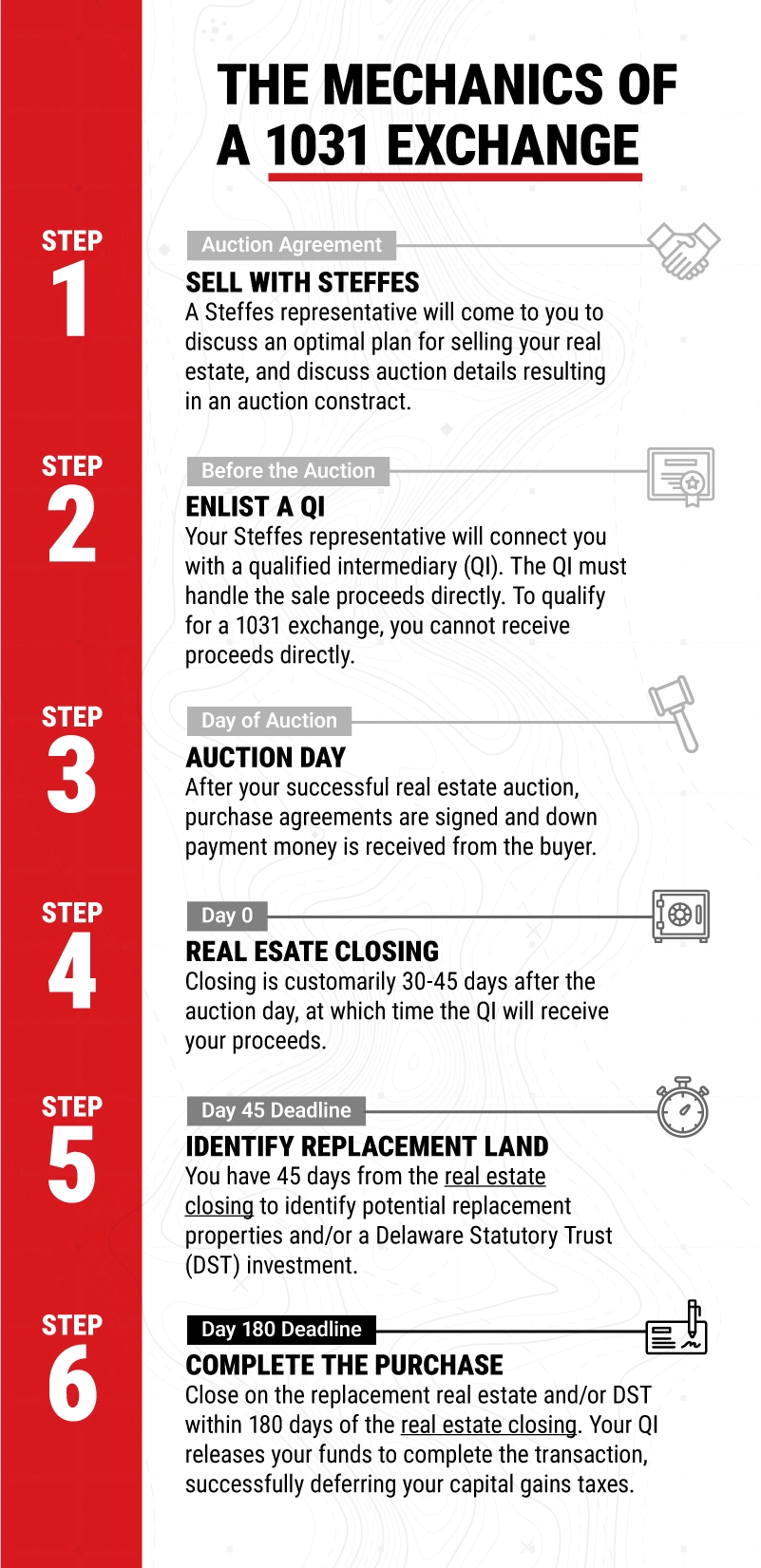
The mechanics of a 1031 exchange
- Sell with Steffes (Auction Agreement): A Steffes representative will come to you to discuss an optimal plan for selling your real estate, and discuss auction details resulting in an auction contract.
- Enlist a QI (Before the Auction): Your Steffes representative will connect you with a qualified intermediary (QI). The QI must handle the sale proceeds directly. To qualify for a 1031 exchange, you cannot receive proceeds directly.
- Auction Day (Day of Auction): After your successful real estate auction, purchase agreements are signed and down payment money is received from the buyer.
- Real Estate Closing (Day 0): Closing is customarily 30-45 days after the auction day, at which time the QI will receive your proceeds.
- Identify Replacement Land (Day 45 Deadline): You have 45 days from the real estate closing to identify potential replacement properties and/or a Delaware Statutory Trust (DST) investment.
- Complete the Purchase (Day 180 Deadline): Close on the replacement real estate and/or DST within 180 days of the real estate closing. Your QI releases your funds to complete the transaction, successfully deferring your capital gains taxes.
Can you use a 1031 Exchange for farmland?
Yes. Farmland, agricultural land, ranchland, and many other investment real estate assets can qualify for a 1031 exchange. A 1031 exchange allows landowners to sell investment property and reinvest the proceeds into another qualifying property while deferring capital gains taxes.
For many farmers, landowners, and agricultural investors, a farmland 1031 exchange provides an opportunity to preserve equity, improve property holdings, consolidate operations, or transition into passive real estate investments without triggering an immediate tax liability.
Does Agricultural Land Qualify for a 1031 Exchange?
Yes. Agricultural land is generally considered like-kind to other forms of investment real estate.
Must Agricultural Land be Exchanged only for other Agricultural Land?
No. A common misconception is that farmland must be exchanged only for other farmland. In reality, IRS rules allow agricultural landowners to exchange into many types of investment real estate. Any property held for use in a trade or a business, or held for investment, can be exchanged for another property for use in a trade or a business, or for investment.
Examples of qualifying replacement properties include:
- Farmland and cropland
- Ranchland and pastureland
- Recreational land
- Commercial real estate
- Industrial property
- Multifamily apartment buildings
- Warehouses and storage facilities
- Delaware Statutory Trust (DST) investments
Because of these broad rules, an agricultural land 1031 exchange can be used to reposition assets, improve cash flow, or reduce management responsibilities.
How a Farmland 1031 Exchange Works
Engage a 1031 Qualified Intermediary: A Qualified Intermediary (QI) facilitates the exchange and holds the sale proceeds during the transaction. The seller cannot take possession of the funds.
Sell Your Existing Investment Property: (Primary residences generally do not qualify.)
Identify Replacement Property Within 45 Days: IRS regulations require replacement properties to be identified in writing within 45 days of closing on the sale.
Complete the Purchase Within 180 Days: The replacement property must be acquired within 180 days of the original sale to maintain tax-deferred status.
Benefits of a Farmland 1031 Exchange

Defer Capital Gains Taxes
A tax-deferred exchange allows investors to keep more capital working for them instead of paying taxes immediately after a sale.

Improve Agricultural Operations
Producers may exchange lower-performing land for property with stronger soils, better drainage, improved access, or greater productivity.

Consolidate Land Holdings
A 1031 exchange can simplify operations by combining multiple geographically diverse properties into a single property.

Retire From Farming Tax Deferred
Landowners can move from agricultural assets into commercial, industrial, or multifamily real estate while maintaining tax deferral and enjoying income from the new investment.

Generate Passive Income
Some investors use a 1031 exchange to transition from actively managed farmland into passive real estate investments that provide income without day-to-day management responsibilities.
Reverse 1031 Exchanges for Agricultural Land
An ideal property can become available at auction before property you own is sold. Perhaps it is a farm you have been driving by for years, or an opportunity to acquire land in a new area you have been looking to enter.
A reverse 1031 exchange allows investors to acquire the replacement property first and then complete the sale of the relinquished property within the required IRS timeframe.
This strategy is highly flexible and can be very valuable in competitive land markets where desirable farmland or investment properties may not remain available long enough to complete a traditional exchange.
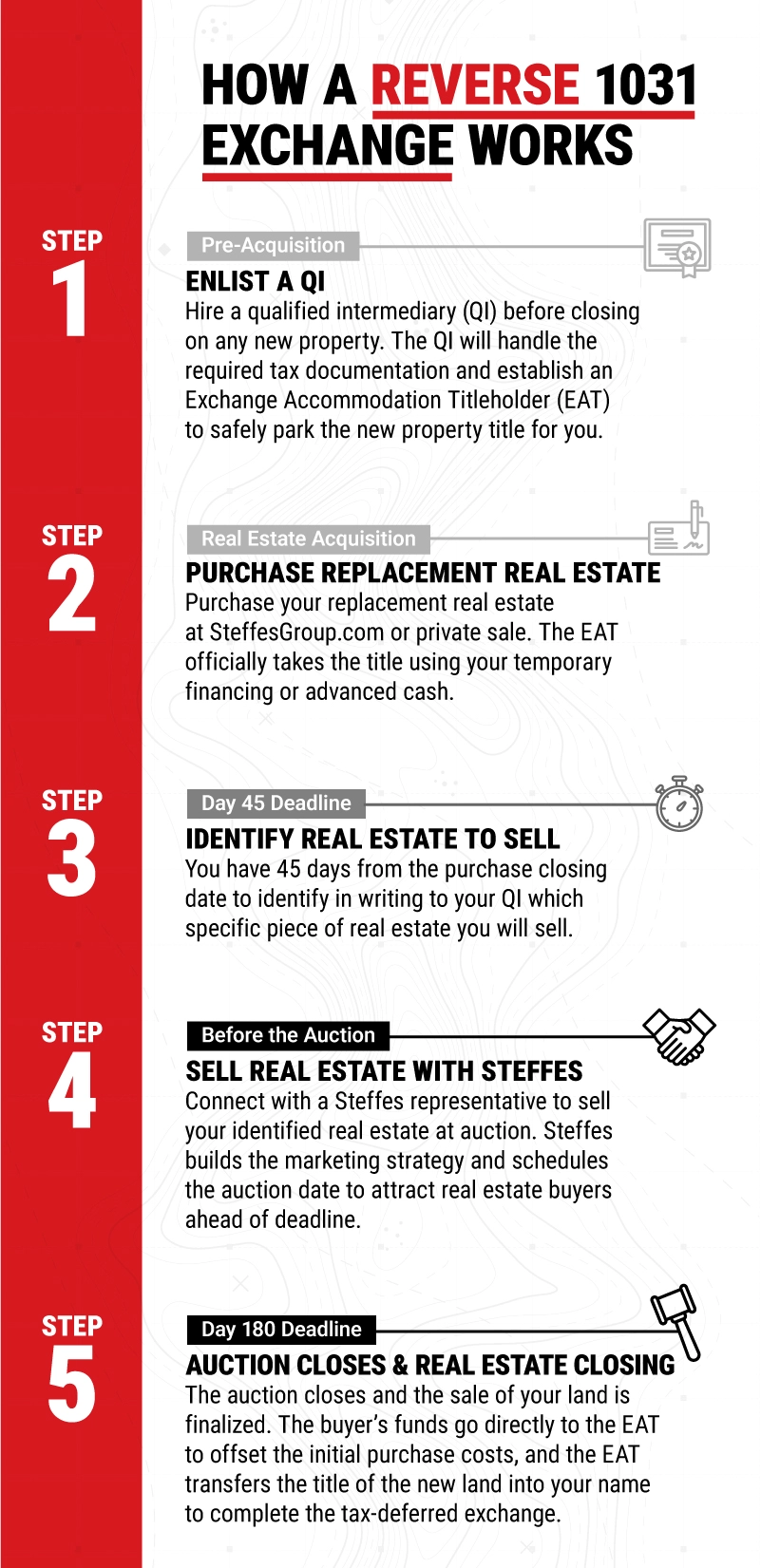
How a reverse 1031 exchange works
- Enlist a QI (Pre-Acquisition): Hire a qualified intermediary (QI) before closing on any new property. The QI will handle the required tax documentation and establish an Exchange Accommodation Titleholder (EAT) to safely park the new property title for you.
- Purchase Replacement Real Estate (Real Estate Acquisition): Purchase your replacement real estate at SteffesGroup.com or private sale. The EAT officially takes the title using your temporary financing or advanced cash.
- Identify Real Estate to Sell (Day 45 Deadline): You have 45 days from the purchase closing date to identify in writing to your QI which specific piece of real estate you will sell.
- Sell Real Estate with Steffes (Before the Auction): Connect with a Steffes representative to sell your identified real estate at auction. Steffes builds the marketing strategy and schedules the auction date to attract real estate buyers ahead of deadline.
- Auction Closes & Real Estate Closing (Day 180 Deadline): The auction closes and the sale of your land is finalized. The buyer's funds go directly to the EAT to offset the initial purchase costs, and the EAT transfers the title of the new land into your name to complete the tax-deferred exchange.
Explore Your 1031 Exchange Options
Whether you are selling farmland, agricultural land, ranchland, or other investment real estate, a properly structured 1031 exchange can help preserve capital and create new opportunities for growth.
The Steffes Group team works with landowners, investors, attorneys, accountants, and qualified intermediaries to support successful land transactions and auction strategies that align with exchange timelines and investment objectives.
Contact UsContact UsFrequently Asked Questions About 1031 Exchange Land
Yes. Farmland can generally be exchanged for commercial real estate because both properties are considered like-kind investment real estate under Section 1031.
Yes. Many landowners use 1031 exchanges to upgrade, consolidate, or relocate farming operations.
Replacement property must be identified within 45 days of selling the original property.
A 1031 exchange defers taxes rather than eliminating them. However, appreciated properties held until death will receive the step-up in basis treatment, washing away gains - and therefore taxes - to the next generation. Jointly held assets only receive a 1/2 step-up. You should consult a financial planning professional for more information.
Yes. The IRS treats mineral rights, oil and gas leases, and easements as real property interests. As long as these interests are held for investment or trade use, they are completely exchangeable and inter-exchangeable with traditional land, farmland, or commercial buildings. Before you accept payment for a pipeline easement, be sure to consult a 1031 professional.
Yes. If your farm includes a house, the property can be split for tax purposes. The home and immediate acreage are treated under Section 121 primary residence rules, allowing up to $500,000 of gain exclusion for married couples. The remaining acreage without a dwelling is treated as investment property and qualifies fully for a tax-deferred 1031 exchange.
A DST is a legal entity that holds title to commercial real estate, and the IRS treats a fractional purchase in a DST as like-kind real estate. If you are a retired farmer looking to exit physical labor, you can exchange your land into a DST. This lets you defer your taxes, collect regular monthly income, and maintain a full step-up in basis for your heirs while avoiding probate.
Missing the identification deadline generally disqualifies the exchange, causing capital gains taxes to become due.
Disclaimer
Steffes Group, Inc. and our representatives are licensed real estate brokers and salespeople across multiple states. We are not tax advisors or qualified intermediaries. This information is for educational purposes and does not replace professional tax, legal, or financial advice.
Every agricultural property and financial situation is unique. We strongly recommend consulting with a licensed tax professional or a 1031 exchange specialist before initiating a transaction.
Our team works closely with leading agricultural tax experts and qualified intermediaries nationwide. Contact Steffes Group today, and we will connect you with a trusted professional who understands your region and property goals.